 how-to
Emergency Mobile Diesel Repairs Queensland: 2026 Guide
Table of Contents
- What You'll Need Before Calling for Emergency Mobile Diesel Repairs
- Step 1: Assess the Breakdown and Secure the Site
- Step 2: Call a 24/7 Diesel Field Service in the Lockyer Valley
- Step 3: Understand Mobile Truck Mechanic Response Time
- Step 4: What Happens During On-Site Heavy Vehicle Diagnostic Services
- Step 5: Approve the Repair and Get Back to Work
- Common Mistakes to Avoid with Emergency Mobile Diesel Repairs in Queensland
- Frequently Asked Questions
Last Updated: October 1, 2026
What You'll Need Before Calling for Emergency Mobile Diesel Repairs
A breakdown on a rural Queensland road at 3am is not the moment to be searching for your vehicle's details. Having the right information ready before you call cuts diagnosis time and gets a technician moving faster.
Emergency mobile diesel repairs Queensland-wide operate on a simple principle: the more the technician knows before they leave the depot, the fewer trips you need. That matters most in the Lockyer Valley and Darling Downs, where a 60km run to a harvester is a 90-minute round trip if the wrong part goes out.
Yarrow Field Maintenance runs 24/7 field service across Southern and Central Queensland. In practice, callers who have five pieces of information ready get a faster, more accurate response than those who ring in cold.
Here's what to have on hand, and how the whole process runs from breakdown to back-to-work.
Vehicle and Equipment Details to Have Ready
Before you dial, pull together:
- Make, model and year of the truck, tractor or machine
- Registration or fleet number, so the technician can match it to service history
- Engine and machine hours, if visible on the dash
- Exact location, including the nearest road marker, gate or landmark
- What happened and when, including any warning lights, alarms or fault codes
- What you've already tried, so nobody repeats a failed step
A common mistake is ringing without the fault code. Many modern diesel engines store diagnostic trouble codes that point straight to the problem. If your dash shows a code, read it out.
Step 1: Assess the Breakdown and Secure the Site
Safety comes before diagnosis. Park as far off the road as the shoulder allows, switch on hazard lights, and set triangles or cones if you're on a highway. On the Bruce Highway or a rural Darling Downs road, visibility is the biggest risk.
Check for obvious causes first. A fuel filter full of water, a flat battery or a loose battery terminal accounts for a surprising share of "dead engine" calls. Look for diesel pooling under the machine, listen for unusual noises, and note whether the engine cranks at all.
If there's smoke, fuel spraying or an electrical burning smell, stop. Do not attempt a restart. Those signs point to faults that a mobile technician needs to inspect before anything is powered up again.
Keep passengers and crew well clear of the machine and traffic. If you're on a construction or mine site, follow your site's isolation procedure before anyone touches the equipment.
Step 2: Call a 24/7 Diesel Field Service in the Lockyer Valley
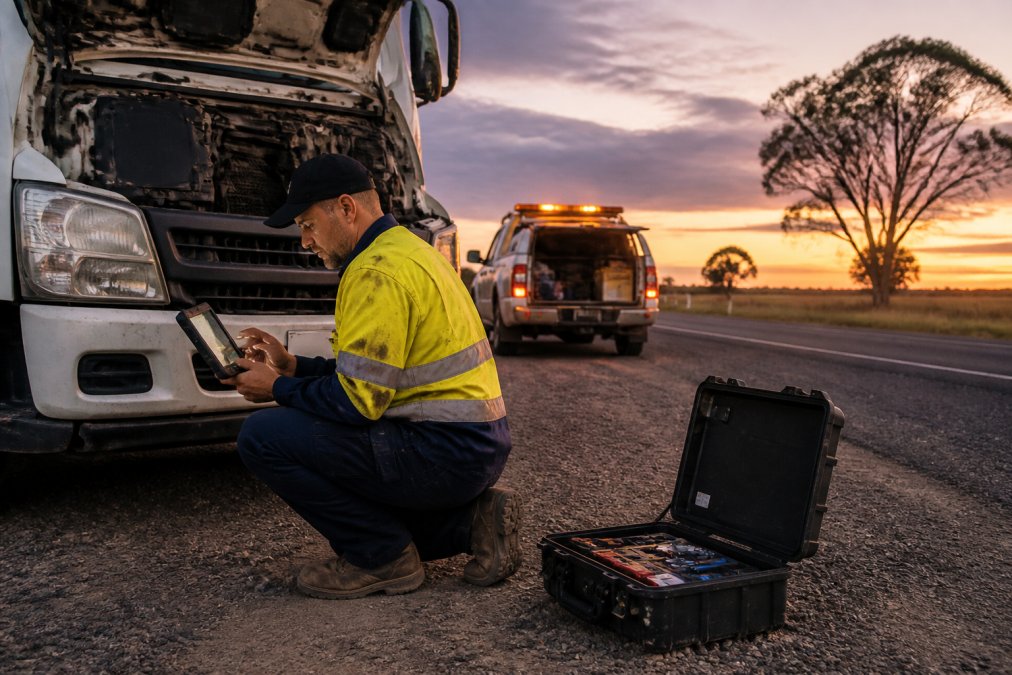
A 24/7 diesel field service Lockyer Valley operators run means a real person answers, day or night. Yarrow Field Maintenance fields calls around the clock and covers Southern and Central Queensland, including the Bowen Basin for mining contractors.
When you call, give the dispatcher your vehicle details, location and fault symptoms. Expect to be asked what you've already checked. That's not an interrogation; it's how the technician decides which parts and tools to load.
Ask two questions before you hang up:
- What's the estimated arrival window? Get a time, not a vague "soon".
- What should I do while I wait? Sometimes the answer is "nothing, stay clear".
If you're an owner-operator with a single truck, say so. Priority is often given to machines that are blocking a road or a production line.
Step 3: Understand Mobile Truck Mechanic Response Time
Mobile truck mechanic response time depends on three things: your distance from the technician's current location, traffic and road conditions, and whether the fault needs a specialist part.
A realistic expectation for a well-run field service is a clear arrival window given at the time of booking, with updates if anything changes. Remote properties in the Darling Downs or Bowen Basin should expect longer travel than a depot on the Warrego Highway. That's geography, not poor service.
While you wait, keep your phone on and stay near the vehicle if it's safe. If you need to leave, tell the dispatcher exactly where the machine is and how to access it, including any gate codes or site inductions required.
Step 4: What Happens During On-Site Heavy Vehicle Diagnostic Services
On-site heavy vehicle diagnostic services begin with a visual inspection and a conversation. The technician will confirm what you reported, then connect diagnostic equipment to read fault codes and live data from the engine control module.
From there, the process typically follows this order:
Stage | What Happens | Typical Duration |
|---|---|---|
Visual check | Leaks, wiring, belts, battery, fuel system | 5-15 minutes |
Electronic diagnosis | Fault codes, live sensor data, ECM scan | 15-30 minutes |
Fault confirmation | Testing the suspected component directly | 10-30 minutes |
Repair | Part replacement or adjustment on site | 30 minutes to several hours |
Re-test and clear codes | Confirm the fix and reset the ECM | 10-20 minutes |
Not every fault can be fixed in the field. Some repairs need a workshop with a hoist or specialised tooling. A good technician will tell you that honestly rather than attempting a repair that won't hold.
For agricultural machinery in the Lockyer Valley, harvest-season breakdowns often involve fuel delivery, sensors or wiring harnesses damaged by dust and vibration. Those are usually fixable on site. Internal engine damage is not.
Step 5: Approve the Repair and Get Back to Work
Before any work starts, you should receive a clear explanation of the fault and what's needed to fix it. Ask for the diagnosis in plain terms and confirm the scope before the technician begins.
Questions worth asking at this point:
- What exactly failed, and why?
- Is this a temporary fix or a permanent repair?
- Are there related components likely to fail soon?
- What's the total cost, including parts and callout?
A trustworthy provider will not pressure you into replacing parts that aren't faulty. If you're told you need new injectors or a full rewire, ask to see the diagnostic evidence. A reputable technician will show you the readings.
Once the repair is done, the technician should clear fault codes, run the engine under load where possible, and confirm the fix. Get a written record of what was replaced and any recommended follow-up.
Common Mistakes to Avoid with Emergency Mobile Diesel Repairs in Queensland
The same handful of errors show up again and again on breakdown callouts. Avoiding them saves time, money and a second callout.
Not securing the site properly. Every year, roadside breakdowns turn into serious incidents because the vehicle wasn't made visible. Hazards, triangles and high-vis clothing are not optional on a highway shoulder.
Calling without the fault code or symptoms. "It just stopped" tells a technician almost nothing. "It lost power, then the engine cut out, and the dash shows a code" tells them where to start.
Assuming the first diagnosis is the whole story. Electrical faults on heavy vehicles can mimic fuel or mechanical problems. A technician who skips proper diagnostics and jumps to parts replacement will often be back a week later.
Skipping the follow-up service. A field repair gets you moving. It doesn't replace scheduled maintenance. Book the machine in for a proper inspection once the immediate job is done.
Using a provider who won't explain the work. You're entitled to understand what failed and what's being done about it. If a technician can't or won't explain, that's a red flag.
For fleet managers running multiple machines across several depots, the real lesson is to build a relationship with a field service provider before you need one at 2am.
Frequently Asked Questions
How quickly can a mobile diesel mechanic reach me in the Lockyer Valley?
Response time depends on your exact location, traffic, and the time of day. For properties in the Lockyer Valley, a 24/7 diesel field service based locally can often reach you faster than one dispatched from Brisbane or Toowoomba. When you call, ask for an estimated arrival window and provide clear directions, including the nearest cross street or property gate. If you are off a main road, sending a pin drop helps the technician find you without delay.
What information should I have ready when calling for emergency diesel repairs?
Have your vehicle or machinery make, model, year, and registration or fleet number ready. Describe the symptoms: does it crank but not start, lose power, overheat, or show a warning light? Note your exact location, including the nearest town or highway marker. Mention any recent repairs or refuelling. If you have a fleet manager or site supervisor, provide their contact details. This helps the technician bring the right parts and diagnostic tools on the first visit.
Do mobile diesel mechanics in Queensland handle heavy vehicle ECM remapping on-site?
Some do, but ECM remapping usually requires a stable power supply and a laptop with manufacturer-specific software. Many field service providers can perform remapping on-site if your equipment is accessible and the battery voltage is stable. For older trucks, remapping can improve throttle response and fuel efficiency, but results vary by engine condition. Ask the provider whether they carry the correct software for your make and model before booking.
Are mobile diesel repair services available 24/7 in regional Queensland?
Many providers advertise 24/7 availability, but actual coverage depends on technician rostering and travel distance. In Southern and Central Queensland, including the Lockyer Valley and Darling Downs, some field service businesses do operate around the clock. When you call after hours, confirm whether you are speaking to a dispatcher or an answering service, and ask for a call-back time if no technician is immediately available. Always keep a backup contact for peak harvest or haulage periods.