 how-to
Book On Site Diesel Repair: 7 Steps to Get Back Running
Table of Contents
- What to Have Ready Before You Book On Site Diesel Repair
- Step 1: Confirm the Job Suits an On-Site Diesel Repair Visit
- Mobile Truck Mechanic Response Time Review: What to Expect
- On-Site Heavy Vehicle Maintenance Checklist for Fleet Managers
- Step 2: Book the Visit and Set Up Safe Site Access
- Step 3: Prepare the Machine and Site Before the Mechanic Arrives
- Step 4: What Happens During the On-Site Diagnosis and Repair
- Step 5: Emergency Roadside Diesel Repair Steps While You Wait
- Frequently Asked Questions
Last Updated: September 28, 2026
What to Have Ready Before You Book On Site Diesel Repair
A breakdown on a rural property or a highway shoulder is expensive time you cannot get back, and the fastest way to cut that time is to have the right information ready before you call. A breakdown on a rural property or a highway shoulder is expensive time you cannot get back, and the fastest way to cut that time is to have the right information ready before you call.
Vehicle and Equipment Details That Speed Up Dispatch
Dispatch runs on specifics. Have these ready before you dial:
- Make, model and year of the machine or vehicle
- Registration or fleet number
- Engine type and approximate hours or kilometres
- Exact location, including property name, gate number and nearest crossroad
- Site contact name and mobile number
Fault Symptoms, Codes and Recent Work History
Symptoms matter more than you think. Note when the fault started, whether it happens hot or cold, and any warning lights or fault codes on the dash. If an OBD-II scanner or the machine's own diagnostic system has logged codes, write them down exactly.
Step 1: Confirm the Job Suits an On-Site Diesel Repair Visit
Not every fault suits a field visit, and the operators who save the most money are the ones who work this out before a truck rolls. On-site diesel repair works best when the fault can be reached, diagnosed and fixed with mobile tooling and the machine does not need to be moved.
Jobs That Usually Suit a Field Visit
- Fuel system faults, lift pump failure, blocked filters, air ingress, injector knock, fuel rail pressure codes.
- Cooling system leaks, hoses, water pumps, thermostats, radiator cores, EGR coolers.
- Electrical and sensor faults, no-start conditions, CAN bus errors, alternator and starter draw, wiring chafe.
- Hydraulic component repairs, hose replacement, cylinder reseal, valve block faults on earthmoving and agricultural gear.
- Driveline issues on heavy vehicles, clutch adjustment, tailshaft and universal joint work, diff seal leaks.
- Air and brake system faults, compressor, governor, dryer and valve problems on trucks and trailers.
Jobs That Usually Need a Workshop
- Full engine rebuilds, cylinder head removal, or anything requiring the engine to come out.
- Cab-off repairs, chassis straightening, or major structural welding.
- Transmission or diff overhauls that need a clean bench, a press and controlled temperature.
- Any fault where the diagnostic path needs a dyno, a load bank or a dedicated test cell.
The Decision Framework
Ask three questions in order:
- Can the fault be reached safely in the field? If the answer needs the cab lifted or the machine split, it is a workshop job.
- Does the fix depend on a part the technician is unlikely to carry? Common consumables, filters, sensors, hoses, belts, injector seals, travel on most service trucks. A turbocharger, an ECM or a transmission valve body usually does not.
- What does recovery cost versus a field diagnosis? A tilt-tray or float move on a heavy vehicle is a significant line item on its own, and it adds downtime while the machine waits for a slot. A field diagnosis that confirms a workshop job is often cheaper than recovering a machine that turns out to be a two-hour fix.
A good provider will tell you upfront when a job is not suited to a field visit rather than send a truck and charge you for a diagnosis that leads nowhere. That honesty is worth more than a fast yes.
Mobile Truck Mechanic Response Time Review: What to Expect
Response time for a mobile truck mechanic depends on where you are, what time you call, and how many jobs are already in the queue. In practice, most operators in Southern and Central Queensland should expect a technician on site within a few hours for a standard call-out, and longer during harvest or peak breakdown periods.
Factors That Affect How Fast a Mobile Mechanic Reaches You
Four things drive the clock:
- Distance from the nearest base. Remote properties take longer than highway breakdowns.
- Time of day. A 2am call on a quiet night usually moves faster than a 9am Monday call.
- Parts availability. If the fix needs a specific injector or sensor, sourcing it adds time.
- Access. A machine parked behind a locked gate with no clear path slows everything down.
If you run a fleet, ask your provider about their after-hours coverage before you need it. Yarrow Group Pty Ltd operates 24/7 across Southern and Central Queensland, which matters when a harvester fails at midnight during harvest.
On-Site Heavy Vehicle Maintenance Checklist for Fleet Managers
A solid on-site heavy vehicle maintenance checklist keeps small faults from becoming roadside emergencies. Fleet managers who run one see fewer unplanned breakdowns because problems get caught on a routine inspection rather than at 3am.
| Check | Frequency | What to Look For |
|---|---|---|
| Engine oil and filters | Weekly | Level, colour, contamination |
| Cooling system | Weekly | Coolant level, hose condition, leaks |
| Fuel system | Fortnightly | Water in separator, filter condition |
| Electrical and battery | Monthly | Voltage, terminal corrosion, fault codes |
| Hydraulics | Monthly | Fluid level, hose wear, cylinder seepage |
| Driveline | Monthly | Grease points, universal joints, diff leaks |
Step 2: Book the Visit and Set Up Safe Site Access
Booking is the easy part. The work is in making the site safe and ready. When you book on site diesel repair, confirm the time window, the site address, and who will meet the technician at the gate.
On-Site Repair Safety Checklist
Run through this before the mechanic arrives:
- Park the machine on level, stable ground away from traffic
- Shut down and isolate the engine; let it cool before work starts
- Lock out and tag out any machinery that could move or start
- Clear a working area of at least 3 metres around the machine
- Provide shade or cover if working in full sun or rain
- Have a fire extinguisher rated for fuel and electrical fires nearby
- Brief the technician on site hazards: livestock, traffic, overhead lines, uneven ground
This checklist is the part most operators skip, and it is the part that keeps people safe. A mechanic working under a hot engine on soft ground is a serious risk, and it slows the job down.
Step 3: Prepare the Machine and Site Before the Mechanic Arrives
- Move the machine to a hard, level surface if you can.
- Clean around the fault area so components are visible.
- Unload the machine if it is carrying a heavy load.
- Have the keys, service manual and any recent repair records on hand.
Step 4: What Happens During the On-Site Diagnosis and Repair
The visit follows a predictable path, and knowing it helps you ask better questions and spot a technician who is guessing.
Stage 1: Safety and Site Set-Up
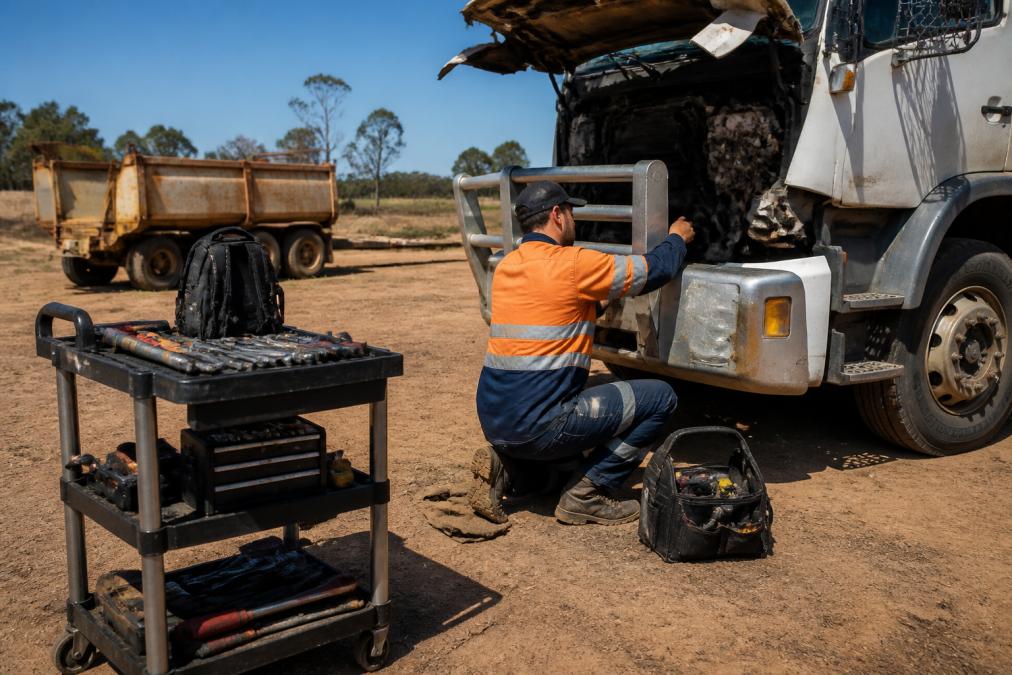
The technician confirms the machine is isolated, chocked and cool, then sets up a work area with the tool trolley and any diagnostic equipment. This is also when they confirm the fault description with you and note anything that changed recently.
Stage 2: Fault Codes and Live Data
Modern diesel diagnosis starts with the electronic control module (ECM). The technician connects a scan tool or laptop running OEM-level software, for example Cummins INSITE, Caterpillar ET, Detroit DiagnosticLink or a generic J1939/J1587 reader, and pulls both active and stored fault codes.
Stage 3: System-by-System Testing
From there the fault is traced through the relevant system:
- Fuel system, supply pressure test, return flow test, injector cut-out test, filter restriction check.
- Electrical, voltage drop tests, resistance checks, sensor signal verification, harness inspection for chafe and corrosion.
- Cooling system, pressure test, combustion gas test in the coolant, thermostat and fan operation.
- Hydraulics, flow and pressure testing at the valve block, cylinder bypass test, hose and fitting inspection.
Stage 4: Repair and Verification
Jobs that need a part the technician does not carry are usually rescheduled once the part is sourced, which is why accurate fault details at booking matter so much.
Step 5: Emergency Roadside Diesel Repair Steps While You Wait
If you are stranded on the roadside, the wait is the hardest part. These steps keep you and the machine safe until the technician arrives:
- Move the vehicle as far off the road as possible and switch on hazard lights.
- Set out warning triangles if you have them, especially on highways.
- Stay clear of traffic lanes and do not stand behind the vehicle.
- Do not attempt repairs on a live fuel system or hot engine.
- Keep the phone charged and stay reachable for the technician's call.
Frequently Asked Questions
What information do I need to provide when booking an on-site diesel mechanic?
Have the make, model and year of the vehicle or machine ready, plus the registration or fleet number. Describe the symptoms in plain terms, such as loss of power, excessive smoke, hard starting or a warning light. If you have fault codes from an OBD-II scanner, pass those on. Give the exact site address, access conditions and a contact name. The more detail you provide, the faster the right tools and parts can be loaded before the mechanic leaves.
How quickly can a mobile truck mechanic respond to a breakdown?
Response time depends on your location, the time of day and how many jobs are already booked. A review of mobile truck mechanic response times shows that metro and near-regional callouts are typically quicker than remote properties, where travel distance adds hours. When you book, ask for a realistic arrival window rather than a flat promise. A provider that operates 24/7 and confirms the booking in writing gives you something to plan around.
Are on-site diesel repairs more expensive than workshop repairs?
Not automatically. On-site work adds a travel component, but it removes towing or float costs, downtime and the labour of moving a machine that may not be drivable. For a harvester stuck mid-harvest or a truck on a highway shoulder, field service often works out cheaper overall. Pricing depends on the fault, parts required and distance travelled, so ask for a quote before work begins rather than relying on a general figure.
What safety protocols should be followed during on-site diesel repairs?
Park on level, stable ground and apply the parking brake. Isolate the battery where practical, and let hot components cool before anyone works near them. Keep bystanders, livestock and other machinery clear of the work zone, and make sure the area is ventilated if the engine runs during diagnosis. Confirm the site has a spotter or traffic control if the vehicle sits near a live lane.